08:00
The strike launches
One hundred and eighty‑eight aircraft — Zeros, dive bombers and level bombers — lift from the Japanese carrier fleet in the Timor Sea.
19 February 1942
A chronological account of the first attacks on the Australian mainland. Behind the timeline are people — those who decided, those who fought, and those whose lives were changed forever.
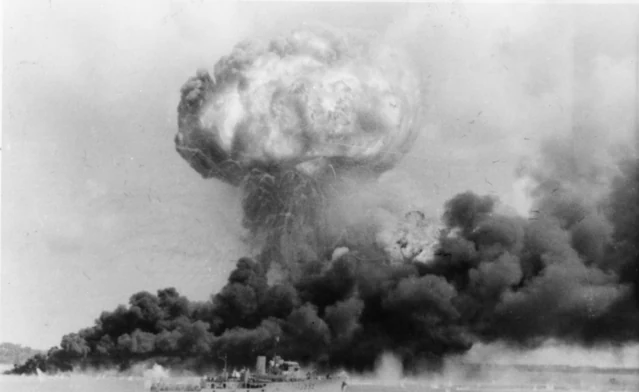
19 February 1942 · AWM 128108
With no siren and no warning, the first bombs fell on the harbour.
One hundred and eighty‑eight aircraft — Zeros, dive bombers and level bombers — lift from the Japanese carrier fleet in the Timor Sea.
The mission on Bathurst Island radios a large formation approaching. It is discounted as the returning American P‑40s.
With no siren and no warning, the first raid breaks over the harbour and town. It will last about forty minutes.
A direct hit kills nine — the postmaster, his family and his staff — sheltering in a trench.
The American destroyer, one of the largest ships in the harbour, is struck by five bombs.
Fifty‑four land‑based bombers return at high altitude to strike the RAAF base at Parap.
She sinks stern‑first. Ninety‑one of her crew go down with her — the heaviest single loss of American life in Australian waters.
At least 235 are dead. Eight ships lie sunk, more than thirty aircraft destroyed. More bombs fell on Darwin than on Pearl Harbour.
The morning, plotted
Archival footage

The same harbour · today
Today the same water lies calm. The wharf remembers.
The Reckoning
Today Darwin stands as a place of remembrance and resilience. Across the city, memorials and wartime sites honour those who served, those who were lost, and the community that rebuilt. The raids did not end that day — they were the first of more than sixty on northern Australia.
Lest we forget.
In Memoriam — those who were lost →
What those forty minutes felt like cannot be scrolled.
It is told standing where it happened.
Every ticket includes both experiences · Stokes Hill Wharf, Darwin